
Northampton County City Directory Shelves
The historical directory shelf in Northampton County is strongest when the collection, place, and year are all named. Easton and greater Bethlehem have different local coverage, and neither should be described as one complete countywide annual run. The Marx Room is the core Easton resource. Bethlehem Area Public Library’s Bethlehem Room is the county complement. A digitized volume can be searched remotely, while many related volumes, maps, and cross-reference works require a visit or a request to the holding institution.
| Collection | Years or coverage | Where held | Access |
|---|---|---|---|
| Easton printed directories | Beginning 1855; confirm exact volume run in catalog | Henry F. Marx Local History Room | On-site historical collection |
| Easton-area phone and cross-reference directories | Exact years not published in the brochure | Marx Room | Address-to-name and name-to-address research |
| 1890 Census Directory of Northampton County | 1890 | Marx Room and a digitized PDF | Online reading plus local collection |
| Bethlehem directories | 1895 to present according to the house-research guide | Bethlehem Room | Noncirculating local-history material |
Gaps deserve an honest label. Public material does not establish every annual Easton volume, every publisher, or every reverse-directory run. Ask staff to verify the year and title before treating a catalog result as complete coverage. Directory publication and compilation cutoffs can also leave a person or address out of a particular volume.
Northampton County Directory Shelves at Marx
The Henry F. Marx Local History Room at Easton Area Public Library is the primary named shelf for an Easton-focused historical-directory search. Its collection holds more than 15,000 local-history and genealogy items, including printed directories, yearbooks, family files, maps, local newspapers on microfilm from 1799, and more than 200 volumes of Northampton County church and cemetery records. That combination helps test whether a printed directory entry fits the same person or address over time.
Easton Area Public Library’s Marx Room also holds phone and cross-reference directories, which makes it useful when the only starting point is a historical address. The material is Easton and surrounding-region focused. Consult staff or the catalog for each needed year, especially where a household may have been in a township or borough outside the directory’s printed scope.
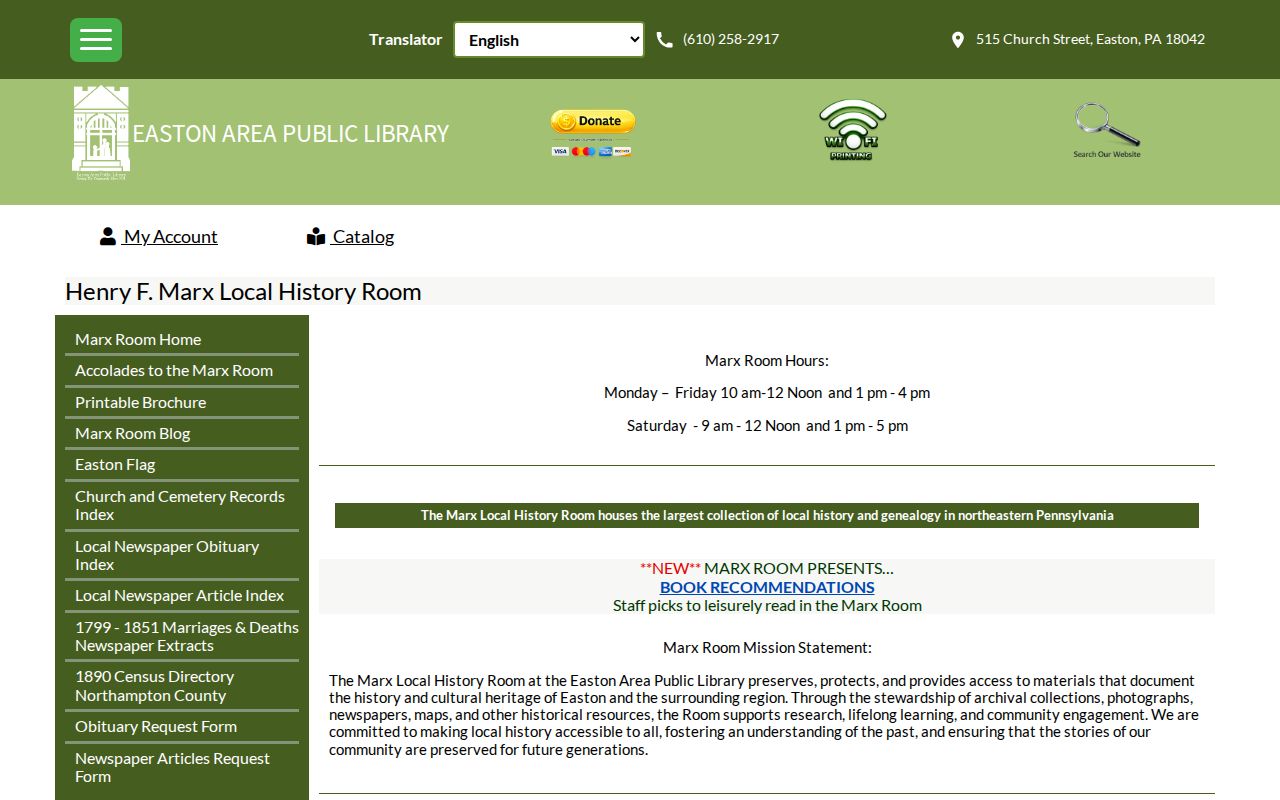
The Marx Room is also the clearest local answer when an online result stops. Its newspaper indexes, maps, directories, and staff-supported on-site resources can turn a name or street listing into a traceable source trail.
Bethlehem Historical Directories
The Bethlehem Room at Bethlehem Area Public Library keeps a separate local-history collection at the Main Library, 11 W. Church Street, Bethlehem. Its noncirculating holdings include books, directories, clippings, photographs, maps, microfilm, and archival collections. The library’s house-research guide states that directories run from 1895 to the present. An older guide identifies selected early volumes, including Scholes Directory of the Bethlehems, Directory of the Bethlehems, and later Polk Directory.
The selected documented titles include 1900-01, 1904, 1906, 1911, and 1917-18. They show why a printed directory title should be recorded exactly rather than summarized as a generic county collection. The public material does not verify a full run or all publishers, so inspect the physical volume or catalog for the exact title, publisher, and year. The Bethlehem Room is reached at 610-867-3761, and its reader can save or email results.
Note: A directory’s stated city can cover a historical community differently from the current municipal map, so preserve the printed place name with the citation.
Read Northampton County Directory Entries
Read each printed directory entry as a historical transcription, not a current profile. The digitized 1900-01 Bethlehem material used by Lehigh University’s Beyond Steel project demonstrates the useful parts of an entry: person name, street address, occupation wording, employer wording, marital-status notation, and a source image. The 1890 Census Directory likewise needs its municipality section recorded, not merely its page number. A printed name or address should stay in its original form until another source supports a connection.
| Printed name | Copy initials, spelling, and any name variant exactly as displayed. |
|---|---|
| Municipality section | Records the directory’s own geographic context, such as a South Easton section. |
| Street wording | Preserve the historic address and abbreviation before comparing a modern map. |
| Occupation or employer wording | Useful period context when the particular volume prints it; do not expand an abbreviation by guesswork. |
| Source image or page | Retain the page or image citation so the entry can be checked again. |
- Criss-cross directory
- A reverse, address-ordered section that can connect a historical address back to a listed name for the period it covers.
- Householder index
- An index arranged around household or address information when a particular volume supplies one; its scope follows that volume.
- Abbreviation key
- The volume’s printed explanation of shortened words or symbols. Capture it when present before interpreting an entry.
A directory may omit people, use a compilation cutoff, or cover only selected municipalities. A missing entry is a reason to test a nearby year, newspaper, census, church record, or map, not proof that the person was absent from Northampton County.
Map Northampton County Directory Addresses
Lehigh University’s Beyond Steel historical GIS shows how a printed directory becomes more useful when kept in its original geography. Its core source is Sholes’ Directory of the Bethlehems, 1900-1901, paired with related census and map material. The project maps historical 1900 locations and retains linked source imagery rather than quietly converting every place to a current street label.
Beyond Steel’s historical GIS project provides a documented model for comparing a name, historic address, occupation wording, employer wording, and marital-status notation. It is a source-based historical project, not a substitute for the original directory or an assertion about a present address.
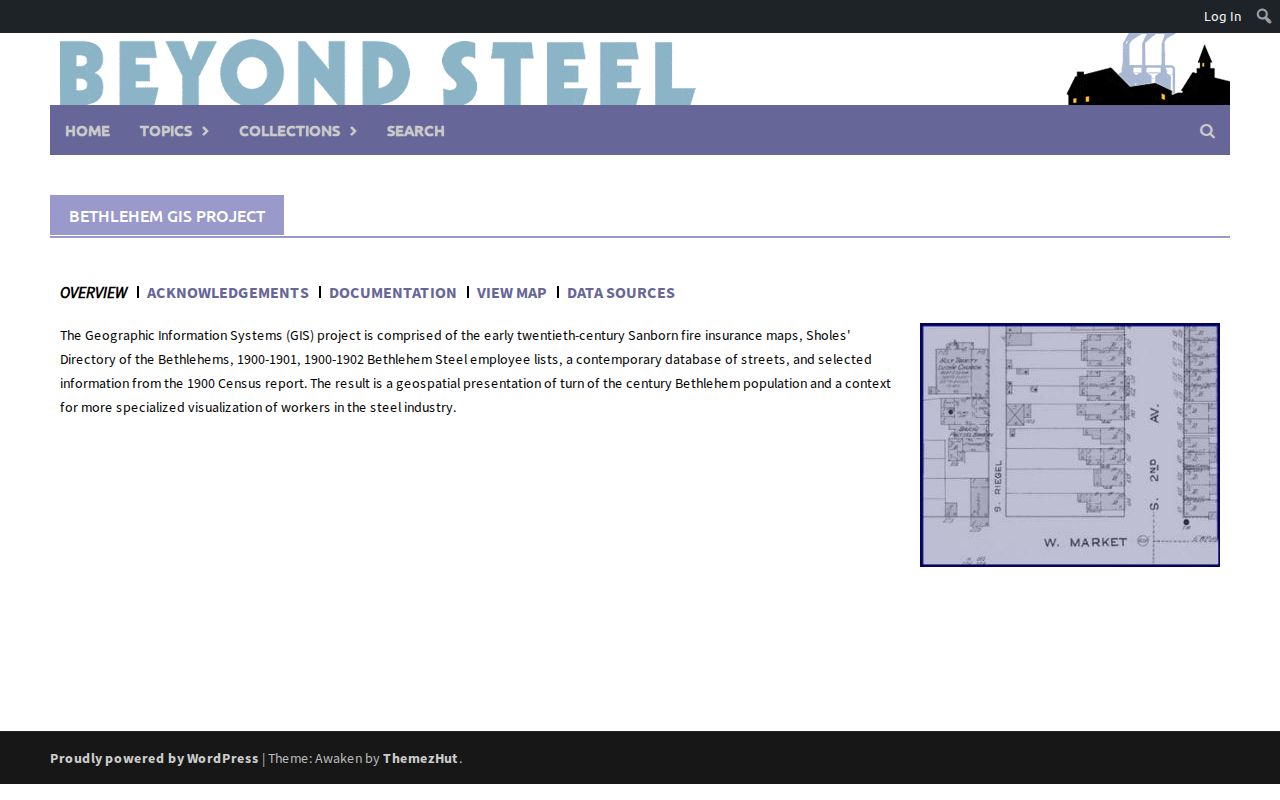
Maps and transcription work together here. The image or volume preserves the printed evidence, while the historic map helps explain where that period’s address belonged.
Keep Northampton County City Names
Bethlehem presents a specific address-continuity problem. Five municipalities merged into the City of Bethlehem in 1917, and many street names changed, especially in South Bethlehem. An older source can therefore be geographically correct even when its municipality or street wording differs from a current map. Keep the printed form in the citation, then use period maps and related records to document any connection.
This is a strong reason to pair a printed directory with a contemporary map rather than automatically standardizing the address. The 1860 Northampton County map includes insets for Easton, Bath, Bethlehem, Freemansburg, and Nazareth, while the Library of Congress Easton Sanborn item from 1963 has 107 sheets. Each answers a different time question. Neither is a substitute for a printed directory entry.
Note: Historic municipality and street names are evidence, not errors to edit away when reconciling an old Northampton County address.
Northampton County 1890 Census Directory
The 1890 Census Directory of Northampton County is a practical bridge around the lost federal 1890 schedules. Its PDF includes municipality sections, including South Easton Census Directory. Record the section, the name as printed, and the street or address wording. The source may not include modern fields such as parcel ID, ZIP, mailing address, or every household member.
Use the volume beside, not instead of, the broader Marx Room collection. A name in the 1890 directory can be checked against directory years on either side, local newspapers, church and cemetery indexes, maps, deed timing, and later released federal census records. That comparison turns a one-year snapshot into a sourced local-history trail.
Northampton County Directory Newspapers
The Marx Room’s newspaper holdings can carry a household between printed-directory years. Microfilmed local newspapers begin in 1799, and the local article index has searchable blocks for 1799-1899, 1900-1920, 1921-1961, 1962-1972, 1973-1996, and 2005-2007. An indexed notice, obituary, civic item, or property reference should be cited by newspaper title, date, and page after the underlying item is inspected.
The Marx Room newspaper article index offers a documented remote fallback. The library charges $5 per article, accepts mail requests with a ten-item cap and stamped return envelope, and can email copies after it receives the form and payment. The oldest local issue in the collection is the American Eagle, Vol. 1 No. 1, dated May 10, 1799.
Church and cemetery records can supply a second route where the directory misses a family. The Marx Room index covers 28 churches compiled in 1945 by Easton Public Library personnel under the WPA. Its source code points to a congregation, record type, and date range, rather than replacing the underlying volume.
Northampton County Directory Moravian Records
For early Bethlehem and Nazareth family research, the Moravian repositories provide a different, carefully bounded source layer. Moravian Archives in Bethlehem maintains the Moravian Roots database, whose search fields include record or event, last name, first name, From year, and To year. Its indexed Bethlehem Congregation registers include runs from 1742-56, 1802-37, 1838-54, 1854-65, and First Moravian South Bethlehem from 1861-1905.
Moravian Roots can lead from a name variation to a historical register, and results or reproductions may involve credits. The Moravian Historical Society in Nazareth adds digitized congregational, memoir, correspondence, estate, mission, business, school, and early-map material. These are historical family and community sources, not evidence of a current location.
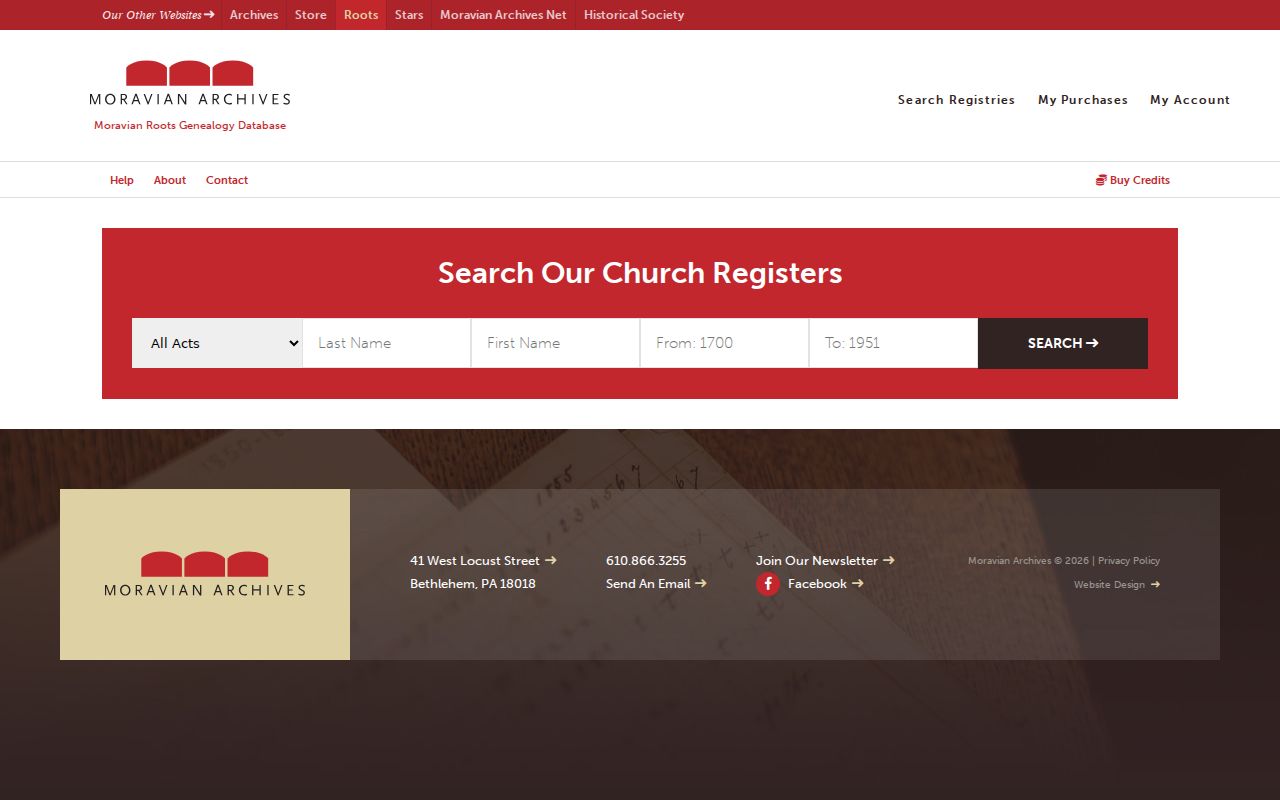
Keep original spellings and source language in the research notes. Northampton County records move through Moravian, German-language, church, industrial, and Lehigh Valley contexts, so a name variation needs evidence before it is treated as the same person.
Northampton County Directory Archives
The Northampton County Historical and Genealogical Society, presented through the Sigal Museum, is the county’s official historical society and maintains the Moyer Library and Archives among its locations. It is a useful countywide preservation contact when an address sits outside Easton’s local directory focus or when the next useful source is a local-history collection rather than a county record index.
The Society’s Sigal Museum locations page establishes its countywide role. Detailed collection and current-hours fields were not available in the captured public material, so use its research-contact or appointment rules before planning a request. Lehigh Township Historical Society is another localized repository with books, church records, documents, photographs, obituaries, cemetery records, and family material available by appointment.
Repository choice follows the place and era. Easton research often begins at Marx; greater Bethlehem research may begin at the Bethlehem Room; early religious-community material may belong at a Moravian repository.
Trace Northampton County Directory Families
Historical directories are especially useful for tracing a household across the years between federal censuses. Begin with the target name or address in a confirmed volume. Copy the printed name, municipality, address, and any context field exactly. Then move backward and forward through nearby directory years. Use a cross-reference volume for the inverse address trail, and pair the sequence with census years, deed-transfer timing, newspaper notices, maps, church records, or cemetery sources as the evidence calls for.
- Find the earliest confirmed printed-directory entry and record the volume title, year, municipality section, page, spelling, and address wording.
- Check the prior and following directory years, noting an address change, altered initials, a new marital notation, or a missing entry without assuming why it occurred.
- Use an Easton-area cross-reference directory when available to test the historical address from the address side.
- Pair the directory sequence with the matching released federal census, which currently reaches through 1950, and retain the date difference between sources.
- Close a gap with the Marx Room newspaper index, church or cemetery source, map, or a recorded-property trail that fits the same place and period.
Disappearance from a directory can mean a move, death, a changed spelling, a selected geographic scope, a compilation cutoff, or an omitted listing. It is not a conclusion by itself. Historic Easton Cemetery has recorded roughly 42,000 individuals but no online person search, while Bethlehem Cemetery offers an institutional location search with first and last name fields and location sorting. Use those sources to document a historical timeline clue, not a present address.